Last checked
CELPIP Speaking Task 4 questions with sample answers
Good Task 4 answers explain likely next events and connect each prediction to a visible clue. The task reuses the Task 3 picture and gives you 30 seconds to prepare and 60 seconds to speak.
How to use these Task 4 samples
These answers turn an unfinished action into a possible next event. A sleeve being rolled up suggests participation; hands above a drip tray and an offered towel suggest drying. Compare the prediction with its clue before judging the vocabulary. A clear future sentence still needs a reason to belong to this picture.
Try a pictured question before reading the answer. In preparation, pair each likely event with the detail that supports it. Speak for 60 seconds, then compare your connections with the sample’s. The unseen question at the end shows its picture and has no sample answer, so use it for a first attempt.
The samples differ in how confidently they predict events. The kitchen answer develops a dramatic chain of accidents; the curling answer explicitly leaves the stone’s final position unknown. Study the useful connections while questioning certainty that goes beyond the evidence. Do not memorize an accident sequence and force it onto another scene. On a second attempt, choose a plausible alternative outcome and explain what would need to happen first. Listen for the difference between describing an action already underway and stating what you expect next. Your answer should spend its time developing those next steps.
Task 4 (Making Predictions) gives you 30 seconds to prepare and 60 seconds to speak. Every question and answer below is original and unofficial, written for CLB Mock; none is taken from a real test. For format and strategy, read the Task 4 guide.
Question 1: Outdoor skating rink at dusk: what happens next
Look again at the picture of an outdoor skating rink. What do you think will most probably happen next? Describe your predictions in as much detail as you can, and base them on what you can see in the picture.
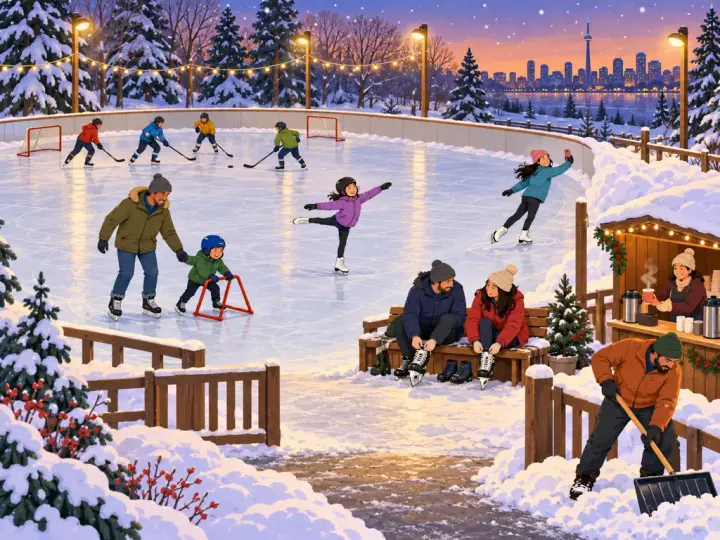
Looking at this rink, I can predict a couple of things fairly confidently. To start with, the puck from the kids' hockey game is sliding straight toward the little boy and his dad, so I think it's going to bump into the boy's skates. He'll probably lose his balance and sit down hard on the ice, but his father will help him up and he'll be fine. Then the teenager who's skating backward while taking a selfie isn't watching where he's going at all. In a second, he's going to crash right into that snowbank, and his friends will probably laugh. Also, since the snow is starting to come down harder, the man with the shovel will be busy for the rest of the evening. Finally, I'd bet the couple on the bench will grab a hot chocolate before they head out.
What the answer covers: Uses a range of future and probability language; Predicts the puck reaching the beginner and the outcome; Predicts the backward-skating teenager hitting the snowbank; Grounds a further prediction in the snow, the shovel or the hot chocolate stand.
Why it works: Content/Coherence links the moving puck and distracted teenager to immediate consequences. “will probably” and “I’d bet” vary probability Vocabulary. Task Fulfillment focuses on next events, although “he’ll be fine” and friends laughing go beyond visible evidence. Try changing: Predict that the father notices the puck early and explain how he might prevent the fall.
Question 2: Farewell party in the office kitchen: what happens next
Look again at the picture of a farewell party in an office kitchen. What do you think will most probably happen next? Describe your predictions in as much detail as you can, and base them on what you can see in the picture.

I think the party is about to reach its big moment. The young woman hiding the gift bag will probably step forward soon and present it to the man who's leaving. He'll likely be surprised and a little emotional, and someone might ask him to give a short speech. After that, everyone will grab a slice of cake. However, before any of that, I suspect the man pouring juice will finally realize his cup is overflowing. He'll probably grab a handful of napkins and apologize while juice drips onto the floor. Meanwhile, the man in the doorway looks stressed about his phone call, so I'd guess he'll have to leave the party early to deal with some kind of work emergency. He might just wave goodbye from the door. Finally, I imagine the card will be passed around for everyone to sign.
What the answer covers: Predicts the gift presentation and the departing coworker's reaction; Predicts the overflowing cup being noticed and cleaned up; Predicts the man on the phone leaving, linked to his expression; Uses a variety of future and speculative forms (I suspect, I'd guess, might).
Why it works: Content/Coherence connects the hidden gift with a presentation and the overflowing cup with cleanup. “I suspect” and “He might” offer varied probability Vocabulary. Task Fulfillment includes several next actions, though the work emergency remains a guess from the caller’s expression. Try changing: Have the caller finish the conversation and rejoin the group, explaining your uncertainty.
Question 3: Restaurant kitchen at dinner rush: what happens next
Look again at the picture of a restaurant kitchen during the dinner rush. What do you think will most probably happen next? Describe your predictions in as much detail as you can, and base them on what you can see in the picture.
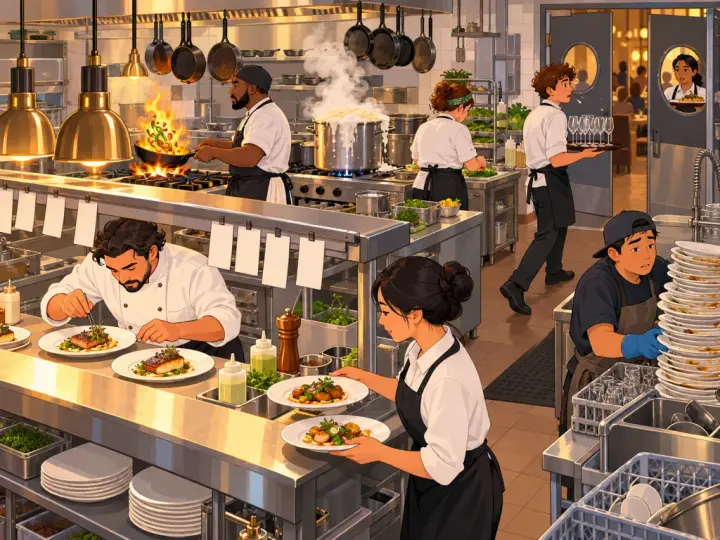
Honestly, I think this kitchen is about thirty seconds away from a small disaster. The most obvious problem is the swinging door. The trainee is heading toward it with a tray of wine glasses, and a server is about to push through from the other side, so they'll almost certainly collide. Most of those glasses will probably smash on the floor, and the trainee will be mortified. Then, while everyone turns to look, the pot on the back burner will keep boiling over, and it might even put out the gas flame, so someone will have to rush over and turn it down. On top of that, the dishwasher's tower of plates is already leaning, so if anyone bumps into it during the confusion, it's going to come crashing down. Still, I expect the head chef to calmly take charge.
What the answer covers: Identifies the most likely event (the collision at the swinging door) and explains the cue; Predicts chain reactions (the pot boiling over, the plate tower); Uses a wide range of probability language (almost certainly, might, if…, I expect); Ends with a reasoned overall outcome.
Why it works: Content/Coherence develops the doorway problem into a chain of interruptions. “mortified” and “boiling over” add specific Vocabulary. The conditional “if anyone bumps into it” makes the plate collapse dependent on another event; “almost certainly collide” is less cautious. Try changing: Predict a warning that stops the collision and explain which person might notice first.
Question 4: Food bank sorting day: what happens next
Look again at the picture of a food bank warehouse. What do you think will most probably happen next? Describe your predictions in as much detail as you can, and base them on what you can see in the picture.
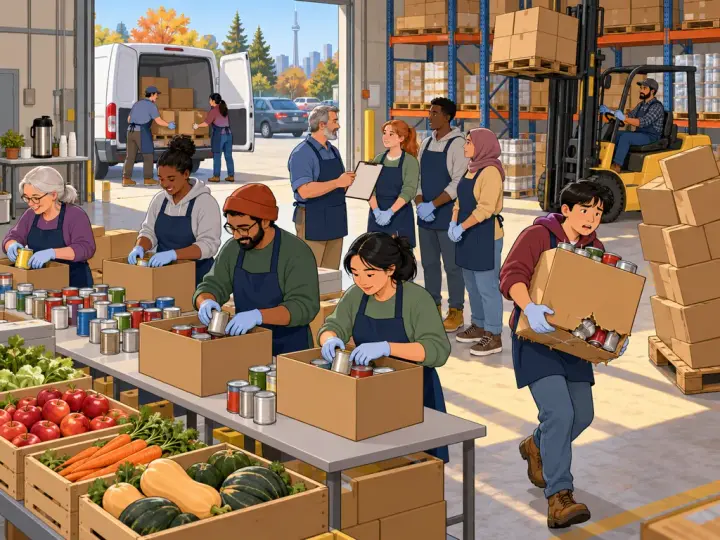
Based on what I can see, I think the teenager carrying the heavy box is about to have a problem. The bottom of the box is already tearing, so in a few seconds, it'll probably give way and cans will spill all over the floor. A couple of nearby volunteers will likely rush over to help, and someone will grab some tape to reinforce the next box. That'd be a useful lesson for the new volunteers. Speaking of them, once the supervisor finishes explaining things, they'll most likely join the others at the sorting tables. Another thing I noticed is the tilting stack of boxes next to the forklift. If the driver isn't careful when he backs up, he might knock it over. Finally, the delivery van is almost full, so I think it'll head out soon to drop off food at community pantries.
What the answer covers: Predicts the torn box giving way and others' reactions; Predicts what the new volunteers will do next; Identifies the tilting stack and the forklift as a risk (conditional); Predicts the van leaving, with a purpose.
Why it works: “already tearing” supplies evidence for the first prediction, strengthening Content/Coherence. “reinforce” adds precise Vocabulary for the proposed response. Task Fulfillment moves beyond the accident to the new volunteers’ next activity, and the forklift risk is conditional. The delivery destination is speculative. Try changing: Have someone support the box before it breaks and explain the likely response.
Question 5: Trying the marine demonstration
Look again at the picture of the marine demonstration in Ucluelet. What do you think will most probably happen next? Describe your predictions in as much detail as you can, and base them on what you can see in the picture. Visitors' gestures indicate their likely next interactions.
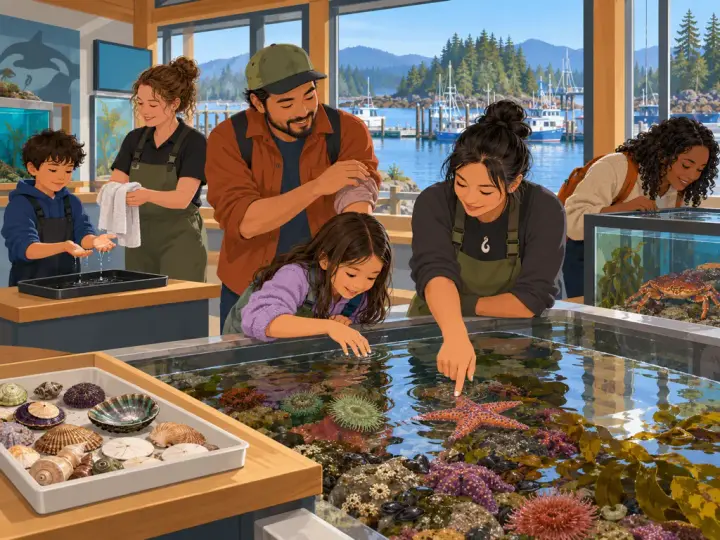
The guide appears ready to demonstrate how to touch the sea star gently. With a finger positioned just above it, the demonstration will probably happen before the girl lowers her own hand into the water. I expect her to copy the guide rather than grab the animal. Her father is rolling up a sleeve, so he may join in once she has had a turn. The towel exchange on the left is even more immediate. The boy will likely take it from the attendant and dry his hands over the tray, keeping drips contained. The woman at the crab tank might lean closer if the crab moves, although we can't predict the animal's behaviour from this view. For the next minute, the main change should be the girl moving from watching the demonstration to trying it herself.
What the answer covers: Predicts a gentle demonstration before the girl's attempt; Uses the rolled sleeve as evidence of participation; Connects wet hands and the offered towel to drying.
Why it works: Content/Coherence sequences the demonstration before the girl’s attempt, then treats the towel exchange as more immediate. “may join in” expresses probability through suitable Vocabulary. Task Fulfillment stays close to gestures and explicitly limits the crab prediction with “we can’t predict the animal’s behaviour”. Try changing: Let the girl hesitate and explain how the guide might respond.
Question 6: Following the curling stone
Look again at the picture of the players on the Dauphin curling sheet. What do you think will most probably happen next? Describe your predictions in as much detail as you can, and base them on what you can see in the picture. Sweeping and the delivery sequence may change next.
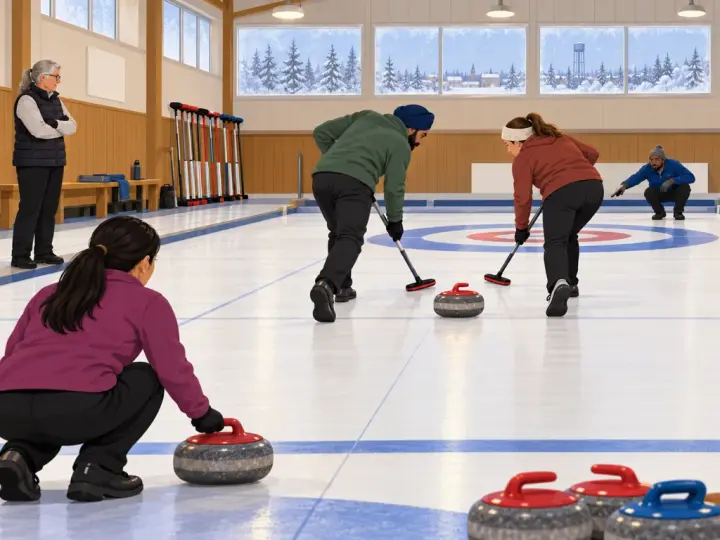
The two players following the moving stone seem ready to sweep. Their broom heads are hovering over the ice, and the teammate at the far end is pointing along the stone's route, so a signal to begin could come shortly. I expect the stone to continue toward the target, but we can't tell exactly where it will stop from this single view. The crouching player near us will probably wait until the current stone finishes travelling before preparing a delivery. Having a hand on the next handle suggests readiness rather than an immediate release. The instructor may comment once the first attempt is complete, especially if the players turn to look for guidance. For now, attention will likely stay on the moving stone and whether sweeping helps it reach the intended position within the circular target.
What the answer covers: Predicts possible sweeping from broom and teammate cues; Avoids claiming an exact final stone position; Sequences the waiting player's delivery after the current attempt.
Why it works: Content/Coherence connects hovering brooms to possible sweeping and delays the waiting player’s turn. “could come shortly” gives probability Vocabulary without fixing an exact result. Task Fulfillment recognises the image’s limits with “we can’t tell exactly where it will stop”. Try changing: Predict that the instructor offers guidance before the next delivery, using cautious language.
The same question at about CLB 7
Here is an answer to Question 1 (“Outdoor skating rink at dusk: what happens next”) at a lower level, written for comparison.
I think the two people on the bench will finish putting on their skates and go onto the ice. They will probably skate together. I think that will be very good for them.
The small boy might move slowly with the plastic frame. The man will stays beside him because he looks like he needs help. The hockey puck is coming towards them, so the man might stop it with his foot.
The teenager taking a photo may reach the snowbank because he is looking at his phone. Maybe he stop just before it. Also, the snow is falling, so the man with the shovel will have more work. I think he will clear the edge again.
- Content/Coherence: the comparison provides several clue–event connections but develops them briefly. The CLB 10 sample follows the puck through a predicted fall and assistance, making that sequence more detailed.
- Vocabulary: repeated “I think” and “very good” add little precision. The CLB 10 sample uses “lose his balance” and “crash right into” to describe specific consequences.
- Listenability: “will stays” and “Maybe he stop” disrupt otherwise simple future statements. The CLB 10 sample controls its future forms more consistently, although its spoken rhythm cannot be assessed from the transcript.
- Task Fulfillment: both predict events from the rink. The comparison offers a possible avoided collision; the CLB 10 sample is more developed but its certainty about safety and laughter should not be treated as established fact.
Develop one prediction with an observable reason and a follow-up action. For example, explain how the adult might move the boy away from the puck before they continue practising. That would add useful detail within the same scene.
Task 4 checklist before you record
- Select visible actions or objects that suggest an immediate next event.
- Pair each prediction with the clue that supports it.
- Use probability language that matches how much the picture establishes.
- Keep any chain of events short enough to explain its connections.
- Use a conditional when the outcome depends on someone acting.
- Spend the response on future developments instead of repeating the Task 3 description.
Your turn: an unseen Task 4 question
Use the timer below with this question. There is no sample answer for it on this page, so you cannot read ahead.
Try it now: timed practice
Look again at the picture of the stargazers preparing their Whitehorse equipment. What do you think will most probably happen next? Describe your predictions in as much detail as you can, and base them on what you can see in the picture. Readiness and supporting gestures help explain the next stage.
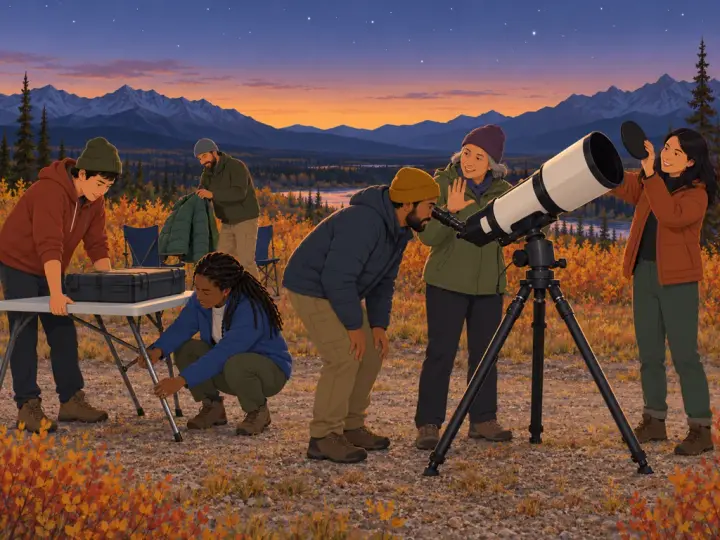
Press Start. Speak out loud when the speaking timer begins, as on test day, where recording starts automatically.
Nothing is recorded on this page. To get an AI-estimated level for an answer, use the app.
Frequently asked questions
Do my predictions have to match the sample answer?
No. The rink could support a fall or an adult preventing one. Explain the clue and the action that would make your chosen outcome plausible.
Should I use “will” for every prediction?
Use a mix that reflects your confidence, such as “will probably”, “might” or a conditional. The curling sample shows how to predict the next action while leaving an exact result unknown.
Can I use the Task 3 answer to prepare for Task 4?
Use it to locate people and notice actions in the shared picture. Then change the purpose of your response: explain likely next events instead of repeating the scene description.
How can I shorten a prediction answer to 60 seconds?
Remove a weakly supported prediction and develop the clearest connections. A complete explanation of a few next events is more useful for practice than rushing through a long chain of guesses.
Sources
Checked October 19, 2026. Rules and fees change: check the official page before you act. celpip.ca pages were read from public archive snapshots because the site blocks automated access.