Last checked
CELPIP Speaking Task 3 questions with sample answers
Good Task 3 answers establish the setting and guide a listener through visible people, actions and positions. You have 30 seconds to prepare and 60 seconds to speak.
How to use these Task 3 samples
These scene descriptions give the listener a route through the picture. The rink answer moves from the far end towards the gate; the marine room answer anchors the central demonstration before looking left and right. Actions distinguish the people more clearly than a list of clothing colours alone. A person pouring juice and a person signing a card have different roles in the scene.
Before reading each answer, inspect its picture and choose your own route. Rehearse with 30 seconds of preparation and 60 seconds of speaking. The unseen question at the end has its own picture and no sample answer, so use it for a first, honest attempt. Afterwards, compare which details you selected and whether a listener could place them.
Pay attention to the boundary between observation and interpretation. A face can suggest a feeling, but a picture cannot establish someone’s private thoughts. Some samples use confident interpretations; their notes identify where softer wording would help. Do not memorize the descriptions. Try the same scene again from another starting point, keeping positions consistent. On replay, check whether pronouns still identify the right person after you move to a different group.
Task 3 (Describing a Scene) gives you 30 seconds to prepare and 60 seconds to speak. Every question and answer below is original and unofficial, written for CLB Mock; none is taken from a real test. For format and strategy, read the Task 3 guide.
Question 1: Outdoor skating rink at dusk
Look at the picture of an outdoor skating rink. Describe what is happening in as much detail as you can, as if you were talking to someone who cannot see the picture.
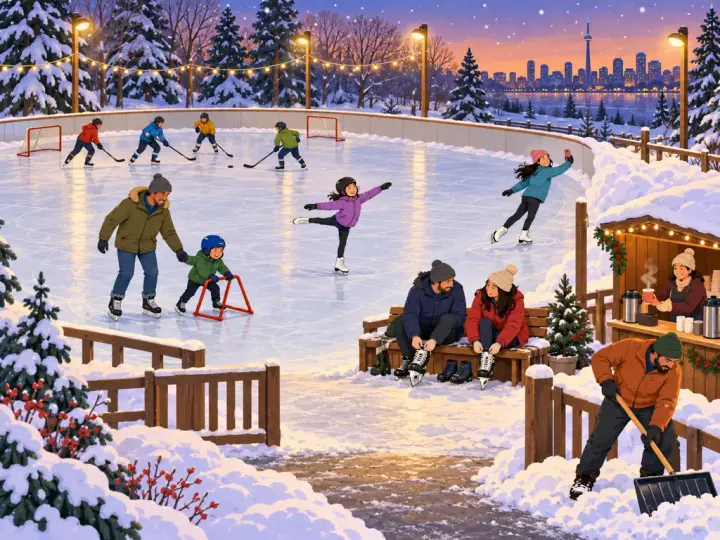
This picture shows an outdoor skating rink in a park, and it's a winter evening, so the rink is lit up by tall lamps and strings of lights. Snow is just beginning to fall, and the trees around the rink are covered in white. At the far end, a group of kids in helmets is playing a casual game of hockey with little nets. In the centre, a dad is holding hands with his young son, who's pushing one of those plastic frames that beginners use, and he looks a bit nervous. Not far from them, a girl in a purple jacket is doing a spin. On the right side, a teenager is skating backward and taking a selfie. Near the gate, there's a hot chocolate stand with steam rising from it, and a couple is lacing up their skates on a bench.
What the answer covers: Gives an overview: an outdoor rink in a park on a winter evening, snow beginning to fall; Describes at least four distinct activities with their positions; Uses precise vocabulary (lacing up skates, a spin, a skating aid); Mentions feelings or atmosphere.
Why it works: “At the far end” and “Near the gate” organize Content/Coherence by location. “lacing up their skates” adds precise Vocabulary for an action outside the main skating area. The explanation of the plastic frame helps a listener picture unfamiliar equipment without needing its name. Try changing: Begin at the gate and trace a consistent route towards the hockey players.
Question 2: Farewell party in the office kitchen
Look at the picture of a farewell party in an office kitchen. Describe what is happening in as much detail as you can, as if you were talking to someone who cannot see the picture.

This picture shows a farewell party in an office kitchen, and the room is decorated with blue and silver balloons. In the middle, there's an older man in a cardigan holding a cardboard box with a plant and a framed photo in it, so he's obviously the one leaving, and he looks quite touched. One coworker is cutting a big sheet cake, and another woman is signing a large card. Behind her back, a young woman is hiding a gift bag and grinning, which suggests it's a surprise. A man near the counter is pouring juice into a cup, but he's chatting with someone and hasn't noticed that it's overflowing. In the doorway, there's a man in a tie on his phone, and he looks worried, like something urgent has come up at work. Overall, it's a warm, slightly emotional gathering.
What the answer covers: Identifies the event and setting first: a farewell party in an office kitchen; Infers who is leaving from visual clues (the box, the plant); Describes several people with actions and positions; Comments on mood and inferences (surprise gift, urgent call).
Why it works: Content/Coherence connects the box to the departing coworker, while “sheet cake” and “overflowing” provide concrete Vocabulary. Task Fulfillment includes several simultaneous activities. However, “obviously the one leaving” is more certain than the visual clue alone warrants, and the urgent work problem is an interpretation. Try changing: Describe the box holder as someone who appears to be leaving.
Question 3: Restaurant kitchen at dinner rush
Look at the picture of a restaurant kitchen during the dinner rush. Describe what is happening in as much detail as you can, as if you were talking to someone who cannot see the picture.
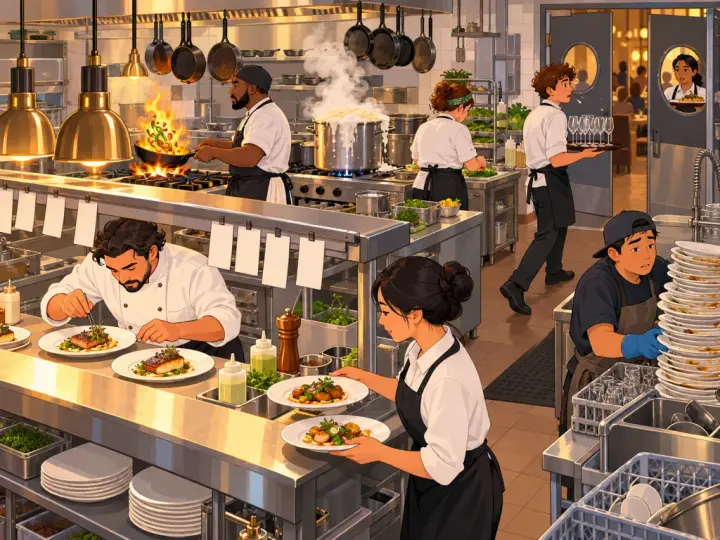
This picture captures the chaos of a restaurant kitchen during the dinner rush. It's crowded and steamy, with stainless steel counters and pans hanging overhead. In the centre, the head chef is plating a dish with tweezers, and she looks totally focused, almost oblivious to the noise around her. Beside her, a line cook is tossing vegetables in a pan that's sending up flames. On the back burner, a huge pot is boiling over, and foam is pouring down the sides, but nobody seems to have noticed. A server is grabbing two plates from the pass, and in the corner, a dishwasher is standing next to a precarious tower of dirty plates. Perhaps the most striking detail is a young trainee who looks nervous as he carries a tray of wine glasses toward the swinging door, while another server is about to come through.
What the answer covers: Captures the overall atmosphere precisely (chaos, dinner rush, steamy); Describes the roles of staff with accurate vocabulary (plating, the pass, line cook, trainee); Highlights unnoticed problems (the pot boiling over, the plate tower); Organizes the description well and ends on the most significant detail.
Why it works: Vocabulary such as “plating” and “the pass” distinguishes kitchen jobs economically. Content/Coherence shifts from the focused chef to unattended problems, ending at the doorway. “a precarious tower” conveys instability through a specific object; the chef’s awareness of noise remains inferred. Try changing: Describe the doorway first, then move towards the counters without predicting a collision.
Question 4: Food bank sorting day
Look at the picture of a food bank warehouse. Describe what is happening in as much detail as you can, as if you were talking to someone who cannot see the picture.

This picture was taken inside a food bank warehouse, and it looks like a busy morning. The space is huge, with high ceilings and tall metal shelves, and there's a big loading door open to the parking lot. At long tables, volunteers in matching aprons and gloves are sorting cans and boxes of food into cardboard boxes. On the left, a supervisor with a clipboard is explaining something to three new volunteers, who are listening carefully, so I think it's their first day. In the background, a forklift is lifting a pallet up toward a high shelf. Closer to the front, a teenager is carrying a heavy box, and the bottom is starting to tear. At the loading door, two people are filling a delivery van. There's also a table of fresh vegetables and apples, and a small coffee station against the wall.
What the answer covers: Introduces the setting: a busy food bank warehouse; Describes the volunteers' tasks with accurate vocabulary (sorting, pallet, loading door); Makes reasonable inferences (new volunteers on their first day); Covers foreground and background details.
Why it works: “In the background” and “Closer to the front” keep Content/Coherence spatially clear. Vocabulary such as “pallet” distinguishes the forklift’s load from individual cartons. The phrase “I think” marks the first-day interpretation, supporting Task Fulfillment through a distinction between observation and inference. Try changing: Start with the loading door and group the indoor activities by location.
Question 5: Summer in a marine touch pool room
Look at the picture of a marine touch pool room in Ucluelet. Describe what is happening in as much detail as you can, as if you were talking to someone who cannot see the picture. Marine displays surround the central pool demonstration.

This marine education room in Ucluelet has a harbour view through its windows, but most people are focused on the creatures inside. At the low touch pool, a guide is holding a finger just over a sea star beneath the water. A girl leans in with her hand hovering above the pool, while her father rolls back his sleeve. Their positions make the demonstration the central activity. On the left, a boy's wet hands are suspended over a drip tray, and an attendant is offering him a towel. To the right, a woman is peering into another tank that contains a crab. A shallow tray of smooth shells sits on a counter as well. The summer setting feels busy without being crowded, and the picture captures several different ways visitors are exploring the marine displays.
What the answer covers: Identifies the setting: a marine touch pool room in Ucluelet; Describes the guide, hovering hand and rolled sleeve at the pool; Includes the towel exchange, crab tank and shell display.
Why it works: Content/Coherence centres the demonstration before moving to the towel and crab tank. “hovering” and “peering” provide Vocabulary for different kinds of attention. Task Fulfillment stays with current gestures, including “rolls back his sleeve”, rather than predicting the next interaction. Try changing: Explain the central group from the girl’s position while preserving the surrounding locations.
Question 6: Winter curling practice in a small arena
Look at the picture of a curling practice in Dauphin. Describe what is happening in as much detail as you can, as if you were talking to someone who cannot see the picture. Curlers are moving or waiting in different positions.
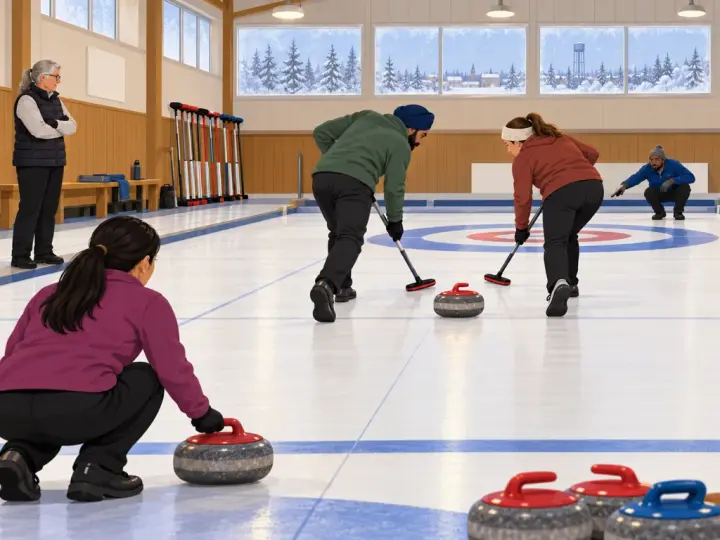
This small curling arena in Dauphin has frosted windows high along the wall, giving it a distinctly wintry feel. A stone is sliding down the sheet toward the circular target at the far end. Two players are moving ahead of it, holding their broom heads just above the ice. Their teammate near the target is pointing toward the line of travel. Closer to us, another player is crouched with one hand resting on the handle of a different stone. An instructor watches from outside the playing surface. Against the wall, there is a bench and a rack holding spare brooms. What stands out is the combination of movement and waiting: one stone is already travelling, two players are following its progress, and someone else is poised at the near end. The scene looks like an organized practice session.
What the answer covers: Identifies the setting: a curling practice in Dauphin; Follows the moving stone, broom positions and pointing teammate; Contrasts active players with the crouching player and instructor.
Why it works: Content/Coherence follows the travelling stone before contrasting it with “another player” waiting nearby. “crouched” and “poised” add precise Vocabulary for that waiting position. Task Fulfillment includes the instructor and equipment without letting background objects displace the main activity. Try changing: Begin with the waiting player and explain how that position differs from the moving group.
The same question at about CLB 7
Here is an answer to Question 1 (“Outdoor skating rink at dusk”) at a lower level, written for comparison.
There are several people at an outdoor ice rink. It is evening and the lights are on. Near the entrance, two people are sitting on a bench and putting their skates on. Beside them there is a place selling hot chocolate.
In the middle, a little boy is holding a plastic frame. A man holds his hand. I think the boy is learning. Some children is playing hockey at the other end, and a girl in purple is turning on the ice.
On the right, a teenager take a photo while skating backwards. I think it looks like a very good evening outside. There is snow on the trees and some snow is falling.
- Content/Coherence: the comparison locates the main groups but saves the snow for the end. The CLB 10 sample establishes the wintry setting first, then moves from the far end through the centre to the gate.
- Vocabulary: “putting their skates on” and “turning” are understandable; “lacing up their skates” and “doing a spin” identify the actions more exactly in the CLB 10 sample.
- Listenability: “children is” and “a teenager take” show agreement slips. The CLB 10 sample controls longer descriptions, including the clause explaining the beginner’s frame; actual pacing remains untested in text.
- Task Fulfillment: both cover the rink’s main activities. The CLB 10 sample helps the unseen listener interpret the frame by explaining that beginners use it, while this version simply names it.
The single most useful revision is to explain the unfamiliar frame’s purpose. It would help the listener understand the central activity without adding a separate topic or invented background.
Task 3 checklist before you record
- Name the setting and main activity in your opening.
- Choose a spatial route before describing individual details.
- Pair people with actions and positions so the listener can distinguish them.
- Explain an unfamiliar object through its appearance or visible use.
- Mark impressions as impressions and leave detailed predictions for Task 4.
- Check subject–verb agreement as you move between one person and a group.
Your turn: an unseen Task 3 question
Use the timer below with this question. There is no sample answer for it on this page, so you cannot read ahead.
Try it now: timed practice
Look at the picture of a telescope setup outside Whitehorse. Describe what is happening in as much detail as you can, as if you were talking to someone who cannot see the picture. Telescope preparations and unstable furniture are both visible.
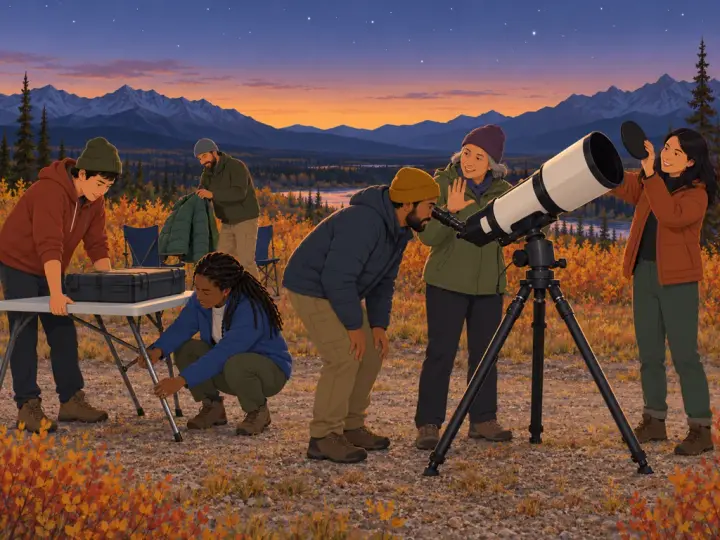
Press Start. Speak out loud when the speaking timer begins, as on test day, where recording starts automatically.
Nothing is recorded on this page. To get an AI-estimated level for an answer, use the app.
Frequently asked questions
Do I need to describe everything named in the sample?
Choose enough connected detail to make the scene understandable within 60 seconds. You can follow a different spatial route and omit minor objects while still explaining the main activities.
Can I invent names or relationships for people in the picture?
Keep your description grounded in what the picture and prompt establish. If a relationship or feeling is only an impression, make that uncertainty clear instead of building an invented backstory.
What if I do not know a word used in the sample?
Describe the object or action in familiar language. For example, the rink answer explains the beginner’s plastic frame by its use, so the listener does not need a specialist name.
Should I describe the scene from left to right?
Any route works if the listener can follow it. Start with the overall setting, then move through the picture in one consistent direction or from the most important activity outwards.
Sources
Checked October 19, 2026. Rules and fees change: check the official page before you act. celpip.ca pages were read from public archive snapshots because the site blocks automated access.