Last checked
CELPIP Speaking Task 8 questions with sample answers
Good Task 8 answers help someone who cannot see the picture imagine its unusual features and understand your advice or request. You have 30 seconds to prepare and 60 seconds to speak.
How to use these Task 8 samples
These descriptions give the listener a familiar shape before explaining unusual parts. A shoe rack curls like a staircase, a study seat resembles a walnut shell, and an easel looks like a sideways umbrella. The comparisons establish something the listener can picture. Position words then show how the pieces fit together, so the description becomes more useful than a list of colours.
Look at a question and its image before reading the sample. Use preparation to identify the listener, the overall object or scene, and a route through the details. Record your response with the timer. Include the decision requested by the prompt, whether that concerns buying furniture, borrowing equipment or choosing where to stand.
Afterwards, ask someone to sketch the object from your recording alone, or check whether your own words locate each part clearly. Compare your description with the sample and notice where it distinguishes observation from a guess about function. Do not memorize an unusual object’s wording: practise transferring the method to a different picture. Our CLB estimates concern these teaching examples, and a clear written description still needs understandable spoken delivery. If a technical name escapes you, explain the visible shape and relationship using familiar words.
Task 8 (Describing an Unusual Situation) gives you 30 seconds to prepare and 60 seconds to speak. Every question and answer below is original and unofficial, written for CLB Mock; none is taken from a real test. For format and strategy, read the Task 8 guide.
Question 1: The Ceiling Shoe Spiral
While viewing a compact rental studio, you see this unusual storage fixture. Send your partner Jun a voice message describing it and explain whether it improves the studio enough to influence your rental decision.
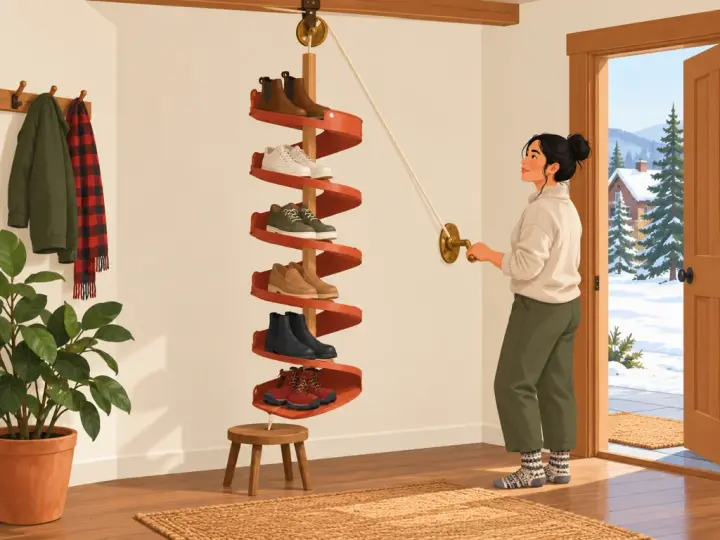
Jun, hello, I'm viewing the studio, and there's a storage fixture you need to picture. A wooden pole hangs from a ceiling pulley, with terracotta shoe shelves curling around it like a spiral staircase. It holds six pairs at the moment, and each shelf has a raised lip. A thick cord runs across the ceiling and down to a brass crank on the wall. Presumably, you lower the rack to choose shoes, then wind it up out of the way. It's clever in such a small room, but we'd need enough clear space underneath whenever it comes down. I'd also ask the landlord to demonstrate the locking mechanism, because I wouldn't want it slowly dropping while raised. This is a useful bonus if it works smoothly, but it wouldn't outweigh the studio's rent or lack of cupboard space for me.
What the answer covers: Describe the suspended spiral rack, cord, and wall crank.; Explain how overhead storage is accessed.; Weigh clearance and secure operation against broader rental needs..
Why it works: “Like a spiral staircase” gives Vocabulary a familiar comparison for the shelves, and Content/Coherence traces the cord to the crank before discussing use. “Presumably” separates inferred operation from observation. Task Fulfillment returns to the rental decision rather than ending at description. Try changing: Explain the rack from the wall crank upward, keeping the connections clear.
Question 2: The Folding Study Shell
You are viewing student furniture at a campus reuse sale. Call your classmate Linh, describe this unusual study seat, and explain whether it would suit her shared study room.
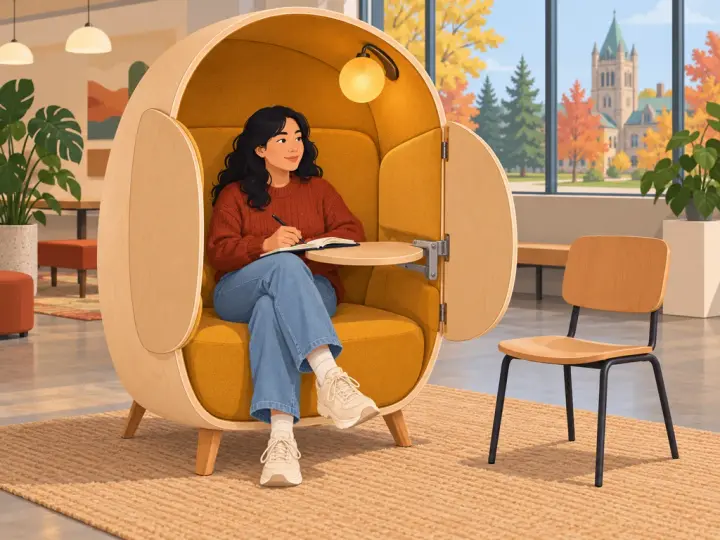
Hey Linh, I've spotted a study seat at the campus sale that might interest you. Picture half a walnut shell standing on four short legs, with a mustard cushion tucked inside. The pale wooden back curves over your head, and two hinged panels can fold inward beside your shoulders. On the right, there's a small desk that swings across your lap. An amber lamp is fixed inside the top, almost like a reading light in a tiny cabin. I reckon the shell would cut down on visual distractions, though I wouldn't expect it to block much sound. It could give you some privacy in our shared study room without taking over an entire corner. Before buying it, I'd sit inside and check whether your laptop fits on the desk. If both feel comfortable, this seems worth considering.
What the answer covers: Describe the shell shape, cushion, panels, desk, and lamp.; Distinguish visual privacy from unproven sound reduction.; Recommend checking comfort and laptop space..
Why it works: “Half a walnut shell” establishes the seat’s overall form for Vocabulary, while the desk that “swings across your lap” locates a moving part. Task Fulfillment distinguishes visual privacy from unproven sound reduction before recommending a comfort and laptop check. Try changing: Describe the desk’s position first after the overview, then explain the panels around the user.
Question 3: The Basket Carousel
At a shop selling used retail fixtures, you see this unusual shopping basket stand. Phone your shop partner Noor, describe it, and advise whether it suits your narrow shop, where customers need clear access and staff have little storage space.
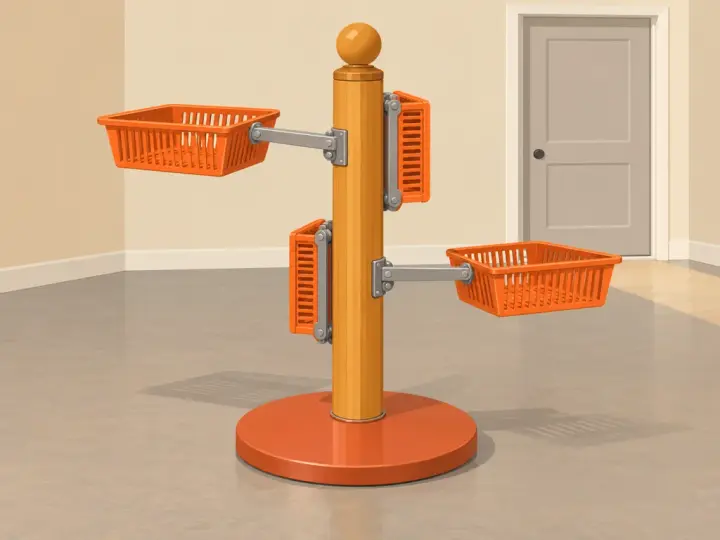
Hi Noor, I'm looking at a basket stand that could solve our storage problem, although there's a catch. Imagine a chest-high wooden carousel on a broad terracotta base. Four silver arms stick out at different heights, each holding an orange shopping basket. Two arms are folded against the column, while the others extend sideways. A knob on top suggests the whole column rotates, letting customers bring a basket toward them. Folded up, it looks compact, but that's misleading because it needs clearance when someone turns it. The higher baskets might also be awkward to reach from a seated position. Given our narrow entrance, I wouldn't buy it just to save storage space. I'd ask the seller for its full operating width and whether every basket can be lowered. Unless both suit our layout, simple stacked baskets would be more practical.
What the answer covers: Describe the rotating column, hinged arms, and wide base.; Distinguish folded storage size from operating clearance.; Weigh reach and access before recommending a purchase..
Why it works: Content/Coherence contrasts folded size with the “clearance when someone turns it”, connecting description to the narrow shop. Task Fulfillment includes reach from a seated position and requests the “full operating width”. The advice follows from how the arms move. Try changing: Keep the same recommendation but explain customer access before discussing storage space.
Question 4: The Umbrella Easel
At a lakeside art club meeting, you see this unusual painting tool. Phone your art partner Tomas, who could not attend, describe it, and advise whether to borrow it for your next outdoor painting session.

Hello Tomas, I'm at the art club, and someone has brought an easel that looks like an umbrella turned sideways. The peach canopy stands upright behind a blank canvas, almost like a round shield. A brass clamp holds the canvas in the middle, and the wooden shaft curves down into three folding legs. Below the canvas, two cream shelves swing outward for paints and brushes. You can see the umbrella ribs around the edges, so the whole thing apparently folds down quite small. I suspect the canopy is intended to shade your work and keep light consistent. It could be useful beside the lake, although that broad surface might catch the wind. I'd borrow it for a calm morning first and check how firmly the legs lock. If it stays steady, we could take it on our longer painting outings.
What the answer covers: Describe the vertical umbrella, canvas clamp, shelves, and legs.; Explain its likely shading and folding functions.; Recommend testing stability in calm conditions..
Why it works: “Almost like a round shield” supplies Vocabulary that locates the upright canopy behind the canvas. Content/Coherence moves through the clamp, legs and shelves before weighing shade against wind. Task Fulfillment ends with a cautious borrowing trial on a “calm morning”. Try changing: Make checking the folding legs your main condition before recommending a trial.
Question 5: The Wool Cloud Workshop
During a textile exhibition in Brandon, you see an unusual installation. Phone your art club organizer Dagny, describe what people are doing, and suggest a suitable way for your group to visit.
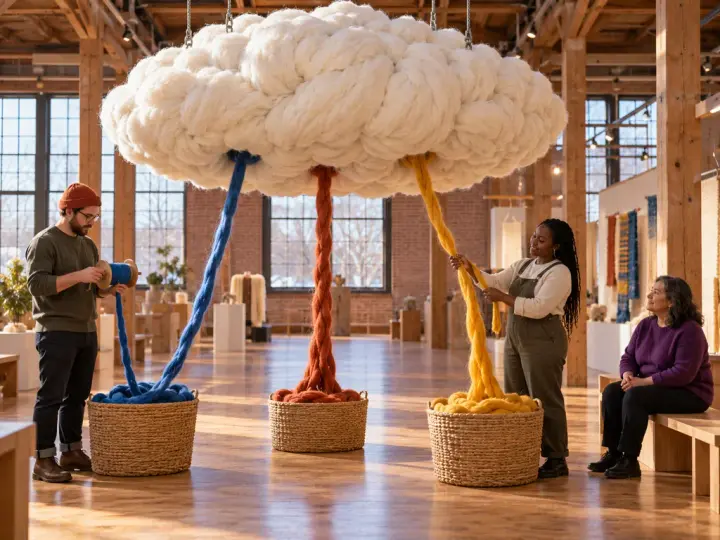
Dagny, the textile installation here turns a cloud into something people can work with. A huge white bundle of wool hangs above head height from four cables. Long blue, rust, and yellow strands come out underneath and trail into three baskets on the floor. One visitor is drawing out a yellow strand, while another winds blue wool onto a wooden spool. A seated person in a purple sweater is watching nearby. It looks as though participants gradually draw material from the cloud, although I'd ask the artist how the activity is meant to develop. Our group would probably enjoy seeing both the sculpture and the winding process. I'd book a small visit so we can gather without filling the clear walkway between the baskets. We should also check whether observers can stay seated while someone explains how the work changes.
What the answer covers: Describe the suspended wool cloud and coloured strands.; Explain the visible participant actions.; Plan a small visit that preserves space and seated viewing..
Why it works: “Above head height” and “underneath” organize Content/Coherence from suspended wool to floor baskets. Vocabulary distinguishes “drawing out” a strand from winding it onto a spool. Task Fulfillment connects the group visit to a “clear walkway” and seated viewing. Try changing: Describe the two active visitors together before mentioning the observer and planning the visit.
Question 6: A Picnic on the Ceiling
While visiting an art centre in Saguenay, you discover an unexpected ceiling display. Send your cousin Malika a voice message describing it and suggest where she should stand to see the effect.
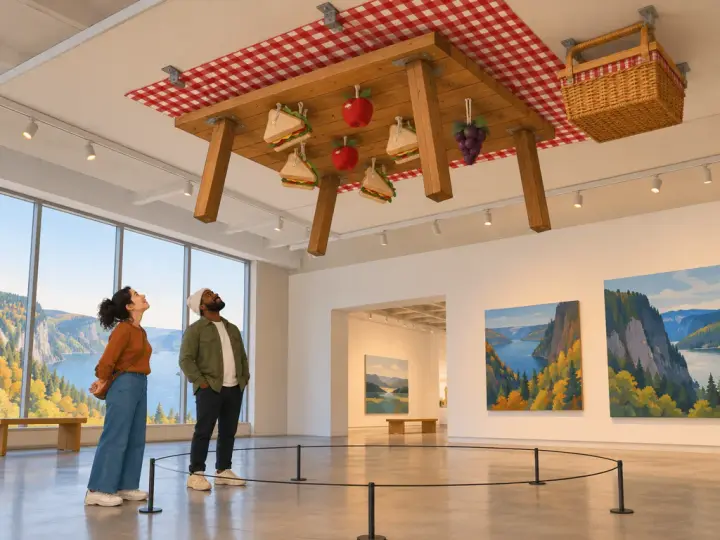
Malika, look up when you enter the next gallery, because the picnic is on the ceiling. A red checked blanket is spread flat above us, and a wooden picnic table hangs upside down with its legs pointing toward the floor. Fabric sandwiches and fruit are tied to the downward-facing tabletop. There's a wicker basket fixed beside the blanket too. From below, it feels as if the entire room has flipped over while the visitors stayed upright. You can see brackets and short ties, so the objects aren't simply balanced there. Two people are standing outside a low circular rope and looking straight up. I'd suggest you stand a little back from that boundary, where you can see the basket and the whole table together. Directly underneath, the tabletop hides some details. It's a wonderfully odd scene once your eyes adjust to it.
What the answer covers: Describe the inverted picnic and attached food.; Explain the visual effect without implying falling objects.; Suggest a position offering a complete view..
Why it works: “The visitors stayed upright” clarifies the inverted scene for Content/Coherence. “Brackets and short ties” gives Vocabulary concrete evidence that the objects are attached. Task Fulfillment ends with a viewing position that reveals the whole table and basket, rather than simply saying to look up. Try changing: Lead the detailed description from the blanket to the attached food.
The same question at about CLB 7
Here is an answer to Question 1 (“The Ceiling Shoe Spiral”) at a lower level, written for comparison.
Hi Jun, I am inside the studio now. There is a very strange place for shoes above me. It has a wooden pole and some orange shelves going round it. The shelves looks like stairs. I can see six pairs of shoes on them.
There is also a rope and a handle on the wall. I think you turn it to move the shoes down. This is very good because the room is small. But we needs to try it before deciding. I think it could be difficult to use every morning. It is a very good idea, but we should still think about the rent before choosing this studio.
- Content/Coherence: this description names a rope and handle but leaves their connection vague. The CLB 10 sample traces the cord across the ceiling to the wall crank.
- Vocabulary: “place for shoes” and “handle” are understandable; “storage fixture”, “pulley” and “raised lip” distinguish the components more precisely in the stronger text.
- Listenability: “The shelves looks” and “we needs” contain agreement slips. The stronger sample controls a longer explanation of lowering and winding the rack up.
- Task Fulfillment: both address Jun and weigh the rental decision, but the stronger answer identifies clearance, the locking mechanism and cupboard space as specific checks.
Improve the spatial explanation first: trace how the rack, pulley, cord and crank connect. The listener can then understand the possible operation and assess your concern about daily use.
Task 8 checklist before you record
- Have I addressed the person who cannot see the picture?
- Does my opening establish the overall object or unusual situation?
- Can the listener locate each part from my position words?
- Have I used a familiar comparison where a shape is hard to name?
- Are guesses about operation clearly separate from visible details?
- Have I answered the prompt’s practical question before the 60 seconds end?
Your turn: an unseen Task 8 question
Use the timer below with this question. There is no sample answer for it on this page, so you cannot read ahead.
Try it now: timed practice
At a furniture showcase in Edmonton, you see an unusual arrangement of seats. Leave your colleague Violeta a message describing it and explain whether it would suit your spacious reception area.
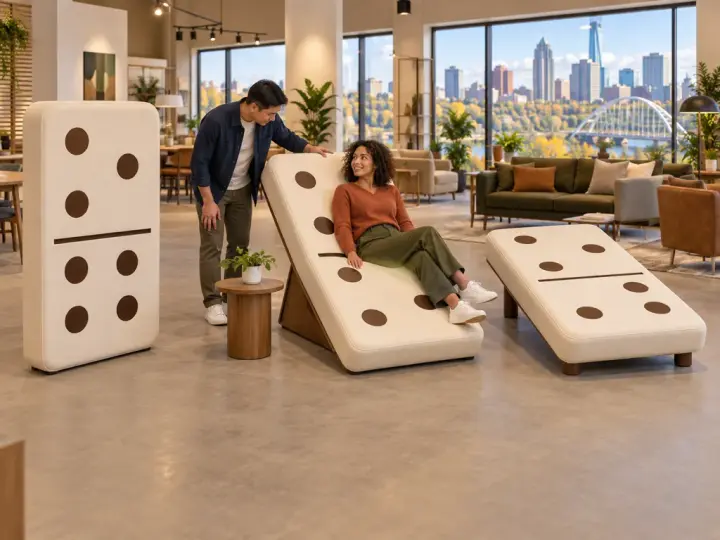
Press Start. Speak out loud when the speaking timer begins, as on test day, where recording starts automatically.
Nothing is recorded on this page. To get an AI-estimated level for an answer, use the app.
Frequently asked questions
Can I use a template for unusual-object descriptions?
Use an adaptable sequence: address the listener, establish the overall shape, locate distinctive parts and answer the practical question. Avoid forcing every picture into the same set of details.
How many words should I say in Task 8?
Practise a complete description and response to the prompt within 60 seconds. Use the sample counts as references, while allowing time to pronounce unfamiliar descriptive words clearly.
Can I invent how an unusual object works?
Describe visible parts first and mark any inferred function as a possibility. If the recommendation depends on an unknown feature, suggest checking it rather than claiming it is present.
What if I cannot name part of the object?
Explain its shape, position or relationship to a familiar object. A clear description of shelves curling around a pole can still help the listener picture the rack.
Sources
Checked October 19, 2026. Rules and fees change: check the official page before you act. celpip.ca pages were read from public archive snapshots because the site blocks automated access.